Loading...
CPVC vs UPVC: Differences, Benefits & Which Is Better for Project
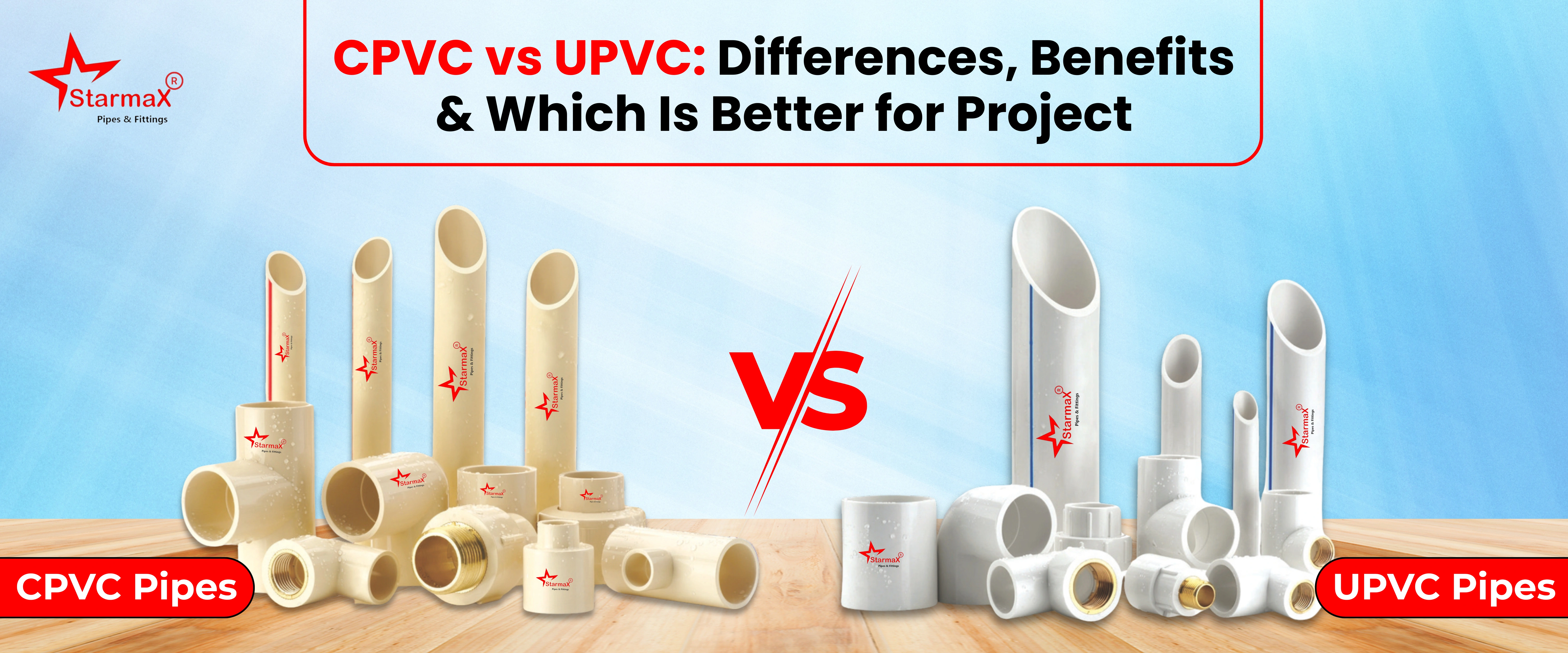
When selecting plumbing materials, either for home or commercial and industrial use, one should know the CPVC and UPVC. They are both made of Polyvinyl Chloride (PVC), which contrasts them in chemical composition, capacity to withstand temperatures, elasticity, and usage.
This is because the CPVC and UPVC differences will give you the right decision on your plumbing system, which will prove to be time and money-saving in the long run.
What is a CPVC Pipe?
CPVC (Chlorinated Polyvinyl Chloride) is a modernised PVC, which is formed after taking one more step of chlorination. This additional chlorine level increases its heat resistance, chemical stability, and strength. The CPVC pipes and fittings are capable of both hot and cold water and are commonly used where the water temperature goes beyond 60°C (140°F), which standard PVC or UPVC cannot withstand.
Key Features of CPVC Pipes
- Can handle both hot and cold water.
- Corrosion-resistant, scaling-resistant, and chemically resistant.
- Not toxic, can be used in drinking water.
- Lightweight, which means it is also easy and quick to install.
- Resistant to temperatures up to 93°C (200°F).
- Commonly used in industrial and residential hot water lines.
Applications of CPVC
- Hot and cold water piping systems.
- Safety water lines and fire sprinkler systems.
- Chemical and factory industrial fluid handling.
- Water treatment facilities.
- Pipelines of chemical transportation.
Because of its versatility and strength, CPVC is often the preferred choice in both commercial and high-end residential projects.
What is UPVC Pipe?
Rigid PVC or UPVC (Unplasticized Polyvinyl Chloride) is a type of PVC in which no plasticisers are added. Lack of these softening agents makes the UPVC hard, rigid, and most importantly, tough in structure. Nevertheless, it cannot be used in hot water applications because UPVC starts to soften when the water temperature reaches 60°C (140°F).
Rigid PVC or UPVC (Unplasticized Polyvinyl Chloride) is a form of PVC pipe that lacks any additives in the form of plasticisers. The absence of such softening agents gives UPVC a hard, rigid, and extremely durable structure.
Key Features of UPVC Pipes
- Excellent chemical and corrosion resistance.
- Rigid, durable, and long-lasting.
- Ideal for cold water supply and drainage systems.
- More cost-effective compared to CPVC.
- Withstands temperatures up to 60°C.
- Eco-friendly and 100% recyclable.
Applications of UPVC
- Cold water plumbing networks.
- Drainage and sewage systems.
- Irrigation and agricultural pipelines.
- Electrical conduit systems for wiring protection.
- Ventilation ducts and low-pressure systems.
UPVC is widely used in residential buildings, especially for non-heated water lines and drain pipes, due to its affordability and strength.
Difference Between CPVC and UPVC Pipes
Here’s a detailed comparison highlighting the UPVC vs CPVC pipe differences:
| Parameter | CPVC Pipe | UPVC Pipe |
| Full Form | Chlorinated Polyvinyl Chloride | Unplasticized Polyvinyl Chloride |
| Chemical Structure | PVC with added chlorine (chlorinated) | PVC without plasticisers |
| Temperature Resistance | Up to 93°C | Up to 60°C |
| Flexibility | More flexible | More rigid |
| Applications | Hot & cold water, industrial use | Cold water, drainage, conduit |
| Cost | Higher due to the chlorination process | More affordable |
| Color | Usually light yellow or cream | White or light grey |
| Pressure Handling | Better for high-pressure systems | Suitable for low-pressure applications |
| Installation Method | Solvent welding or threaded | Solvent cement jointing |
| Lifespan | 50+ years (with proper maintenance) | 50+ years (in cold systems) |
This table clearly illustrates the CPVC pipe vs UPVC pipe comparison across multiple performance aspects. Explore UPVC vs. CPVC pipes - and key benefits to choose the right piping solution.
UPVC and CPVC Differences in Practical Use
The practical UPVC and CPVC difference can be seen when you think of their performance in various temperature and pressure conditions. CPVC pipes are the best when it comes to hot water supply lines because they are more resistant to heat.
In the case of cold water pipes, rainwater, or sewage, the use of UPVC pipes is more appropriate since it is cost-effective and rigid.
Examples:
- Hot water drainage in bathrooms - CPVC
- Rainwater/drainage pipes - UPVC
Transportation of chemicals in the industry - CPVC is used as an anti-corrosion material. Irrigation systems in agriculture - UPVC is cheap and reliable.
Advantages of CPVC Pipes
- High Heat Resistance - Can be used under high temperatures up to 93°C.
- Chemical Resistance - Superior resistance to acid, alkalis, and salts.
- Smooth Inner Surface - Scaling will not take place, and no water flow interruption.
- Leak Free and Strong - Designed for long-term use with minimal damage.
- Potable water - CPVC is authorised under international standards for drinking water.
Advantages of UPVC Pipes
- Cost-Effective - More affordable than CPVC and metal alternatives.
- Rigid and Strong - Excellent structural integrity under moderate pressure.
- Corrosion-Free - Will not rust or corrode even in saline or acidic water.
- Low Maintenance - Requires minimal repair and upkeep.
- Eco-Friendly - Recyclable, with no lead or toxic chemicals.
Which Is Better: CPVC or UPVC?
In plumbing systems and construction projects, there is no single “better” choice—only the right material for the right application.
- Choose CPVC when you need hot and cold water supply, higher pressure handling, or industrial usage.
- Choose UPVC for cold water supply, drainage systems, or budget-friendly installations.
Installation and Maintenance Tips
Whether UPVC or CPVC pipe is used, correct installation ensures long-term performance.
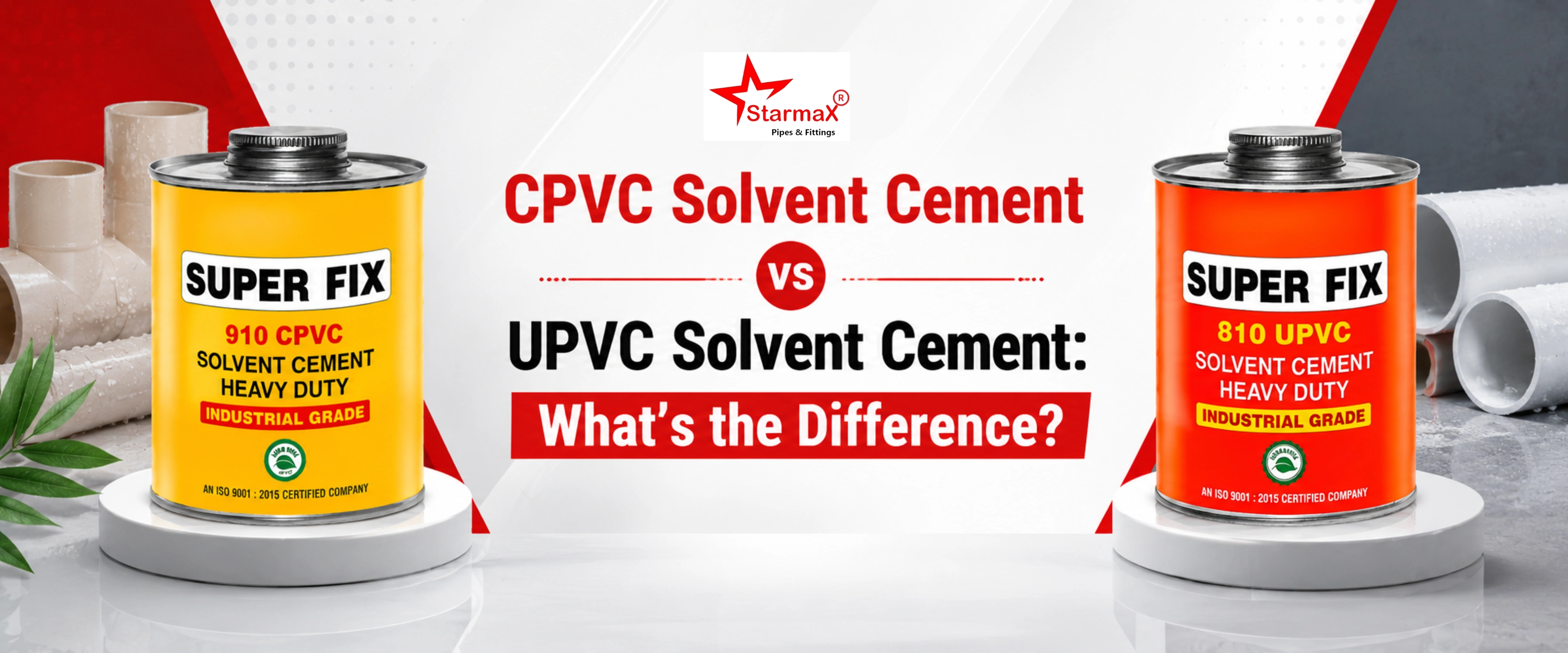
- Use the correct solvent cement for CPVC and UPVC separately.
- Avoid direct sunlight exposure unless pipes are UV-stabilised.
- Provide adequate support to prevent sagging.
- Flush CPVC lines periodically in hard water conditions.
- Inspect joints and fittings regularly for leaks.
Conclusion
Both CPVC and UPVC pipes offer outstanding performance for modern plumbing systems.
- CPVC excels in hot water and industrial applications.
- UPVC is ideal for cold water, drainage, and irrigation projects.
Understanding the difference between UPVC and CPVC helps homeowners, builders, and engineers make reliable, safe, and cost-effective material choices.

Related Blog
WHY STARMAX ?
MAKE IN INDIA- BEST QUALITY PRODUCTS UNDER THE MISSION MAKE IN INDIA
BEST QUALITY PRODUCTS- All products are certified and manufactured as per ASTM standards.
HIGHEST SATISFACTION We assure the customers for 100% statisfaction in terms of price and quality
BEST BUSINESS STANDARDS- we have the mission of providings the products in best business standards i.e.
Free! Get A Quote

"Starmax" is a brand launched by "Naira Group" offering a wide range of CPVC & UPVC pipes and fittings. We are based in India ka Dil- Dilli CHAWRI BAZAR (Delhi).
Our Product
CPVC Pipes and Fittings UPVC Pipes PTMT Taps UPVC Fitting System PVC Plastic Tap Solvent Cement Clampes BrochureContact Us
Mr. Sumit Gupta
Address
3348/1, Gali Peepal Mahadev, Chawri Bazar, Delhi-110006
© 2026 Starmax Pipes. All Rights Reserved.
