
Loading...
CPVC Pipe Sizes in India: Dimensions, Diameter and Complete Size Chart
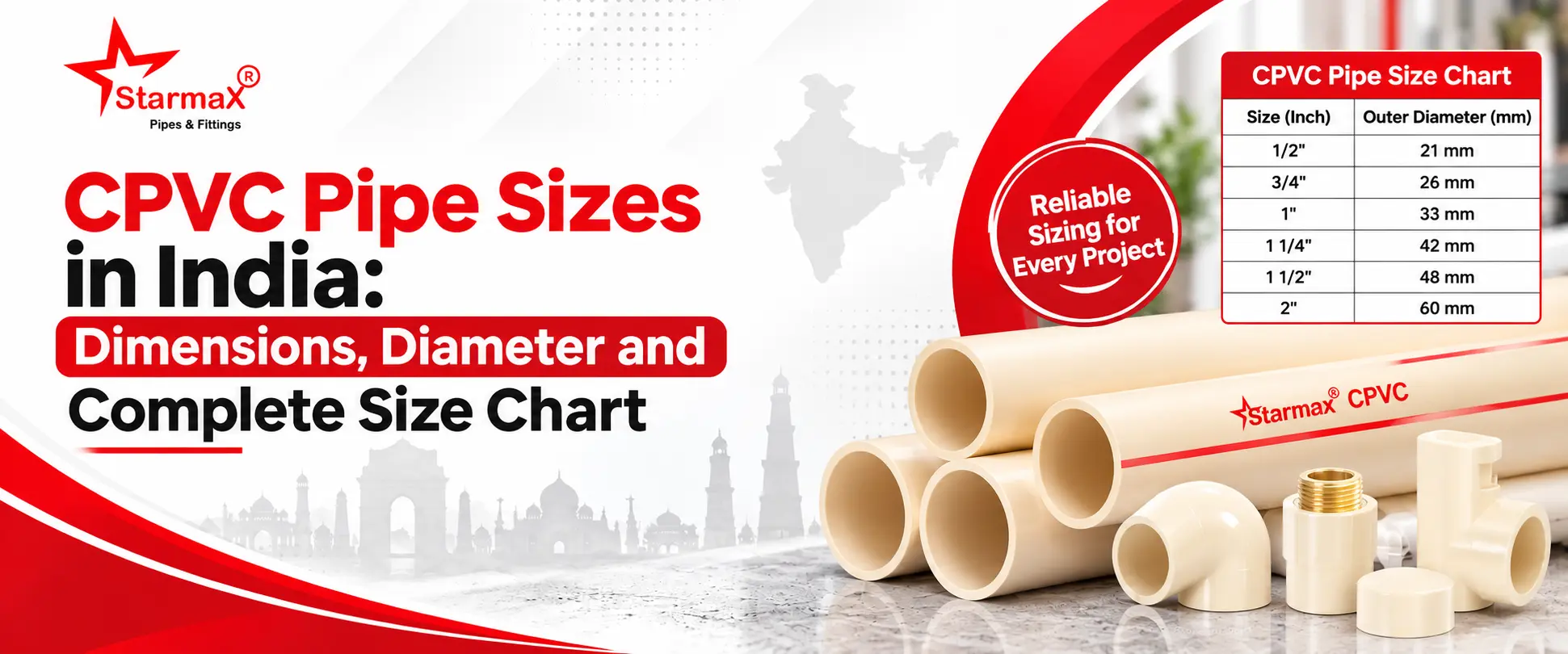
A plumber asks for a half-inch CPVC pipe, but the outside diameter measures nearly 16 mm. Did someone supply the wrong size? Not at all. CPVC pipes use nominal size labels, which do not always match their actual measurements. That difference matters when you buy fittings, replace old lines, or plan hot and cold water plumbing.
Across India, you will see sizes listed in inches and millimetres, along with wall classes such as SDR 11 and Schedule 80. This guide gives you the CPVC pipe size charts first, then explains the measurements and how to choose compatible pipes with confidence.
CPVC Pipe Size Chart in MM and Inches
Common CPVC pipe sizes for home plumbing range from 15 mm (½ inch) to 50 mm (2 inches). Larger sizes are also available for commercial and industrial systems.
In India, two dimensional systems you will commonly encounter are CTS (Copper Tube Size) and IPS (Iron Pipe Size). Their measurements and pipe classes differ, so you should check the relevant system before buying.
1. CPVC CTS Pipe Size Chart — ½ Inch to 2 Inches
CTS pipes are widely used for hot and cold water plumbing in homes and commercial buildings. The following chart shows common sizes with dimensions based on IS 15778.
| Nominal Size | Outside Diameter (mm) | SDR 11 Min. Wall (mm) | SDR 13.5 Min. Wall (mm) |
|---|---|---|---|
| 15 mm (½") | 15.9 | 1.7 | 1.4 |
| 20 mm (¾") | 22.2 | 2.0 | 1.7 |
| 25 mm (1") | 28.6 | 2.6 | 2.1 |
| 32 mm (1¼") | 34.9 | 3.2 | 2.6 |
| 40 mm (1½") | 41.3 | 3.8 | 3.1 |
| 50 mm (2") | 54.0 | 4.9 | 4.0 |
Note: Outside diameters are nominal values. Wall thickness figures are specified minimums. Manufacturing tolerances apply.
Notice the difference between the size printed on the pipe and its actual outside diameter.
For example, a ¾-inch CPVC pipe has an outside diameter of approximately 22.2 mm, while a 1-inch pipe measures approximately 28.6 mm outside.
Also, SDR 11 pipes have thicker walls than SDR 13.5 pipes of the same size. That difference affects the internal opening and pressure rating.
2. CPVC IPS Pipe Size Chart — 2½ Inches to 6 Inches
Larger CPVC pipes are often used in commercial water distribution and suitable industrial applications.
ASTM F441 specifies Schedule 40 and Schedule 80 CPVC pipes.
| Nominal Size | Outside Diameter (mm) | SCH 40 Min. Wall (mm) | SCH 80 Min. Wall (mm) |
|---|---|---|---|
| 65 mm (2½") | 73.0 | 5.16 | 7.01 |
| 80 mm (3") | 88.9 | 5.49 | 7.62 |
| 100 mm (4") | 114.3 | 6.02 | 8.56 |
| 150 mm (6") | 168.3 | 7.11 | 10.97 |
Note: These are reference dimensions for the stated IPS pipe sizes. Confirm product specifications before ordering.
Schedule 80 has thicker walls than Schedule 40 at the same nominal size. Therefore, its internal diameter is smaller.
However, that doesn't mean Schedule 80 is necessary for every installation. The choice depends on operating pressure, temperature, fluid, and system design.
How Do You Read CPVC Pipe Dimensions and Diameter?
A CPVC pipe chart becomes much easier to use once you understand three measurements: nominal size, outside diameter, and wall thickness.
What Is Nominal Pipe Size?
Nominal pipe size is the standard name used to identify a pipe.
For example, ½ inch and ¾ inch are trade sizes. They do not directly represent the outside diameter in inches.
This naming system helps manufacturers, suppliers, and plumbers identify matching components.
However, you must also know whether the pipe follows CTS or IPS dimensions.
What Is the Difference Between Outside Diameter and Inside Diameter?
Outside diameter (OD) measures the pipe from one outer edge to the other.
Inside diameter (ID) measures the open space through which water flows.
The relationship is:
Inside Diameter ≈ Outside Diameter − (2 × Wall Thickness)
Take a 25 mm nominal CTS CPVC pipe with an OD of 28.6 mm.
Using the minimum SDR 11 wall thickness of 2.6 mm:
28.6 − (2 × 2.6) = 23.4 mm
This gives an approximate internal diameter based on those reference dimensions.
Actual measurements may differ due to permitted tolerances.
The outside diameter helps determine fitting compatibility, while the inside diameter affects the available flow area.
What Does CPVC Pipe Wall Thickness Mean?
Wall thickness is the distance between the inner and outer surfaces of a pipe.
Two CPVC pipes can have the same nominal size and outside diameter but different wall thicknesses.
A thicker wall generally provides greater pressure capacity within a comparable material and design system. However, it also reduces the internal opening.
For this reason, selecting a pipe based only on its outside diameter can lead to the wrong pressure class.
What Is the Difference Between SDR 11, SDR 13.5, Schedule 40 and Schedule 80?
These terms describe pipe dimensions and wall classes. They help distinguish pipes that may look similar but have different specifications.
| Pipe Class | Common System | Main Characteristic |
|---|---|---|
| SDR 11 | CTS | Thicker wall than SDR 13.5 |
| SDR 13.5 | CTS | Thinner wall than SDR 11 |
| Schedule 40 | IPS | Thinner wall than Schedule 80 |
| Schedule 80 | IPS | Thicker wall than Schedule 40 |
SDR means Standard Dimension Ratio. It relates the outside diameter to the minimum wall thickness.
As the SDR number decreases, the wall generally becomes thicker for the same outside diameter.
Schedule 40 and Schedule 80 use a different dimensional classification. You should not treat SDR 11 as another name for Schedule 80.
Also, pressure ratings change with temperature.
A pipe that can handle a certain pressure at room temperature may have a lower allowable pressure when carrying hot water.
Always refer to the manufacturer's pressure and temperature ratings for the exact product.
Which CPVC Pipe Size Should You Use for Different Plumbing Applications?
The correct CPVC pipe size depends on how much water the system needs to carry, the pipe length, available pressure, and number of outlets. If you are still comparing materials, read which pipe is best for water supply before finalising the size.
Here are some commonly considered sizes.
| Plumbing Application | Size Often Considered |
|---|---|
| Individual tap or fixture branch | ½ inch |
| Bathroom water supply branch | ½–¾ inch |
| Larger branch serving multiple outlets | ¾–1 inch |
| Main supply within a building | 1 inch or larger |
| High-flow commercial distribution | Larger engineered sizes |
These are starting points, not fixed design rules.
For Bathroom and Kitchen Plumbing
A ½-inch CPVC line is commonly considered for individual fixtures. However, a branch serving several outlets may need a larger diameter.
For example, a bathroom with a shower, basin, and other fixtures may require a different layout from a single kitchen tap.
For Main Water Supply Lines
Main lines carry water to several branches, so the pipes, fittings, and CPVC ball valves should all suit the system. Therefore, they may require larger diameters to manage flow and pressure loss.
A plumber or plumbing designer should calculate the pipe size based on expected demand and the overall system layout.
For Commercial and Industrial Applications
Larger CPVC pipes may suit selected distribution systems where their pressure, temperature, and chemical compatibility are appropriate.
However, choosing a 4-inch or 6-inch pipe simply because the project is large is not enough.
The pipe material, system pressure, fittings, and applicable design standards must all match.
Remember: Bigger isn't always better. Correct sizing supports suitable flow without unnecessary material costs.
Why Doesn't a ½-Inch CPVC Pipe Measure 12.7 MM?
The Nominal Size Trap
This is one of the most common sources of confusion when buying plumbing materials.
Mathematically, half an inch equals 12.7 mm. Yet a ½-inch CTS CPVC pipe has an outside diameter of approximately 15.9 mm.
Why?
Because ½ inch is the pipe's nominal trade size, not a direct conversion of its outside diameter.
Suppose you're replacing an old pipe and buy a fitting based only on the measurement you expect from the printed inch size.
The fitting may not match the pipe.
The problem becomes more serious when CTS and IPS components are confused.
Before buying replacement parts, check three things:
- Nominal pipe size
- CTS or IPS dimensional system
- Fitting specification and compatibility
Practical rule: Never choose a CPVC fitting using inch-to-millimetre conversion alone.
What Should You Check Before Buying CPVC Pipes in India?
Once you've selected a nominal size, a few final checks can help you avoid buying incompatible material.
- Check the dimensional standard. Confirm whether the product follows IS 15778, ASTM F441, or another applicable specification.
- Verify the pipe class. Check for SDR 11, SDR 13.5, Schedule 40, or Schedule 80 markings.
- Match pipes and fittings. Confirm the dimensional system and product compatibility, including the manufacturer's joining instructions.
- Review temperature and pressure ratings. Hot water service can reduce allowable pressure. Use the rating for the actual operating conditions.
- Check the product details. Look for manufacturer identification, size markings, relevant certification, and clear product specifications.
Also, ask about available pipe lengths and compatible CPVC solvent cement before purchasing.
For projects in India, buying a recognised size is only the first step. Choosing a compatible, properly rated system matters just as much.
Conclusion
CPVC pipe sizes become easier to understand once you separate nominal size from actual dimensions.
The charts help you compare outside diameter and wall thickness, while SDR and Schedule classes explain important differences between pipe systems.
Before buying, check the required size, pressure rating, and fitting compatibility.
The right CPVC pipe is not simply the one with the correct inch label. It must also suit the plumbing system.
Frequently Asked Questions
Q1. What Are the Standard CPVC Pipe Sizes Available in India?
Common residential CPVC pipe sizes include 15, 20, 25, 32, 40, and 50 mm, corresponding to ½ inch through 2 inches. Larger sizes are also available for commercial and industrial applications, depending on the pipe system.
Q2. What Is the Outside Diameter of a ½-Inch CPVC Pipe in MM?
A ½-inch CTS CPVC pipe has a nominal outside diameter of approximately 15.9 mm. The ½-inch label is a trade size, not its actual outside measurement. Permitted manufacturing tolerances apply.
Q3. What Is the Difference Between ¾-Inch and 1-Inch CPVC Pipe?
A ¾-inch CTS CPVC pipe has an outside diameter of approximately 22.2 mm, while a 1-inch pipe measures around 28.6 mm. The larger pipe generally provides more flow area, depending on wall thickness.
Q4. What Is the Difference Between SDR 11 and SDR 13.5 CPVC Pipes?
SDR 11 has a thicker wall than SDR 13.5 at the same nominal CTS size. This affects internal diameter and pressure capacity. Select the class using the manufacturer's ratings and the system's operating conditions.
Q5. Can CTS and IPS CPVC Pipes Use the Same Fittings?
Not automatically. CTS and IPS pipes follow different dimensional systems, so their fittings may not be interchangeable. Use fittings specifically designed and approved for the chosen pipe system to avoid poor connections.
Q6. Which CPVC Pipe Size Is Suitable for Home Plumbing?
½-inch and ¾-inch pipes are commonly considered for household branches, while larger lines may serve multiple fixtures. However, the final size depends on flow demand, pipe length, pressure, and plumbing layout.

Related Blog

WHY STARMAX ?
MAKE IN INDIA- BEST QUALITY PRODUCTS UNDER THE MISSION MAKE IN INDIA
BEST QUALITY PRODUCTS- All products are certified and manufactured as per ASTM standards.
HIGHEST SATISFACTION We assure the customers for 100% statisfaction in terms of price and quality
BEST BUSINESS STANDARDS- we have the mission of providings the products in best business standards i.e.
Free! Get A Quote

"Starmax" is a brand launched by "Naira Group" offering a wide range of CPVC & UPVC pipes and fittings. We are based in India ka Dil- Dilli CHAWRI BAZAR (Delhi).
Our Product
CPVC Pipes and Fittings UPVC Pipes PTMT Taps UPVC Fitting System PVC Plastic Tap Solvent Cement Clampes BrochureContact Us
Mr. Sumit Gupta
Address
3348/1, Gali Peepal Mahadev, Chawri Bazar, Delhi-110006
© 2026 Starmax Pipes. All Rights Reserved.
